


Views: 0 Author: Site Editor Publish Time: 2026-05-01 Origin: Site


In financial environments like teller counters, ATMs, and currency exchanges, hardware failure represents more than a minor inconvenience. It creates a major compliance risk. It disrupts secure workflows. Banks handle sensitive operations daily. They simply cannot afford equipment downtime. You might see sprawling point-of-sale setups in retail stores. However, banking facilities are entirely different. Physical space remains highly constrained here. Equipment must run continuously. Staff intervention must remain minimal. Tellers operate behind anti-bandit glass. They manage cash discriminators and dual-monitor setups. There is no room for bulky peripherals on these desks.
This reality makes compact reliability crucial. Enter the 58mm Thermal Receipt Printer. It serves as the pragmatic standard for these strict environments. It perfectly balances tight dimensions with true enterprise-grade durability. You will learn exactly why financial institutions standardize on this specific format. We will explore operational realities, core hardware criteria, compliance standards, and essential deployment strategies to optimize your branch technology.
Space Efficiency: 58mm models easily integrate into secure teller pods and embedded kiosks where 80mm units cannot fit.
Risk Reduction: Hardware with front-exit paper paths and built-in power supplies prevents the most common operational failures (paper jams and cable disconnections).
Cost Control: Evaluating Total Cost of Ownership (TCO) over a 5-year cycle proves that commercial-grade 58mm printers reduce costly IT service calls.
Compliance Ready: Compatibility with BPA-free paper and secure physical integrations supports strict occupational health and data handling standards.
Financial facilities face strict counter space limits. Modern branch designs often utilize open-plan teller pods. These pods have zero tolerance for clutter. Tellers need room for essential tools. They use cash discriminators, secure monitors, and check scanners. You cannot easily fit large hardware into these secure zones. We must maximize every available inch. Heavy equipment clutters the workspace. It also impedes the teller's ability to engage directly with customers.
Procurement teams often debate between 58mm and 80mm printers. The 58mm unit is consistently chosen over the 80mm model for banking applications. Retail stores need 80mm paper to print complex promotional graphics. They print return policies and QR code coupons. In banking, receipts look different. They primarily contain simple alphanumeric data. You will see transaction IDs, account balances, and timestamps. You rarely see complex retail promotions. This renders the wider 80mm format unnecessary. The compact width handles financial data perfectly.
Hardware downtime introduces severe operational penalties. An offline printer creates an immediate bottleneck. A teller station must close if it cannot print receipts. The teller requires a manager override to proceed. This delays service. It impacts queue times heavily. Customers lose trust when branch technology fails. You must prevent these failure points proactively. Reliable hardware keeps the queue moving efficiently.
Feature Matrix | 58mm Format (Banking Standard) | 80mm Format (Retail Standard) |
|---|---|---|
Footprint | Ultra-compact, fits tight teller pods. | Bulky, requires deep counter space. |
Content Layout | Optimized for alphanumeric transaction logs. | Optimized for graphical coupons and policies. |
Integration | Easily embedded into slim ATMs. | Difficult to house in slimline kiosks. |
Paper Waste | Minimal waste for short transactions. | High waste for basic balance inquiries. |
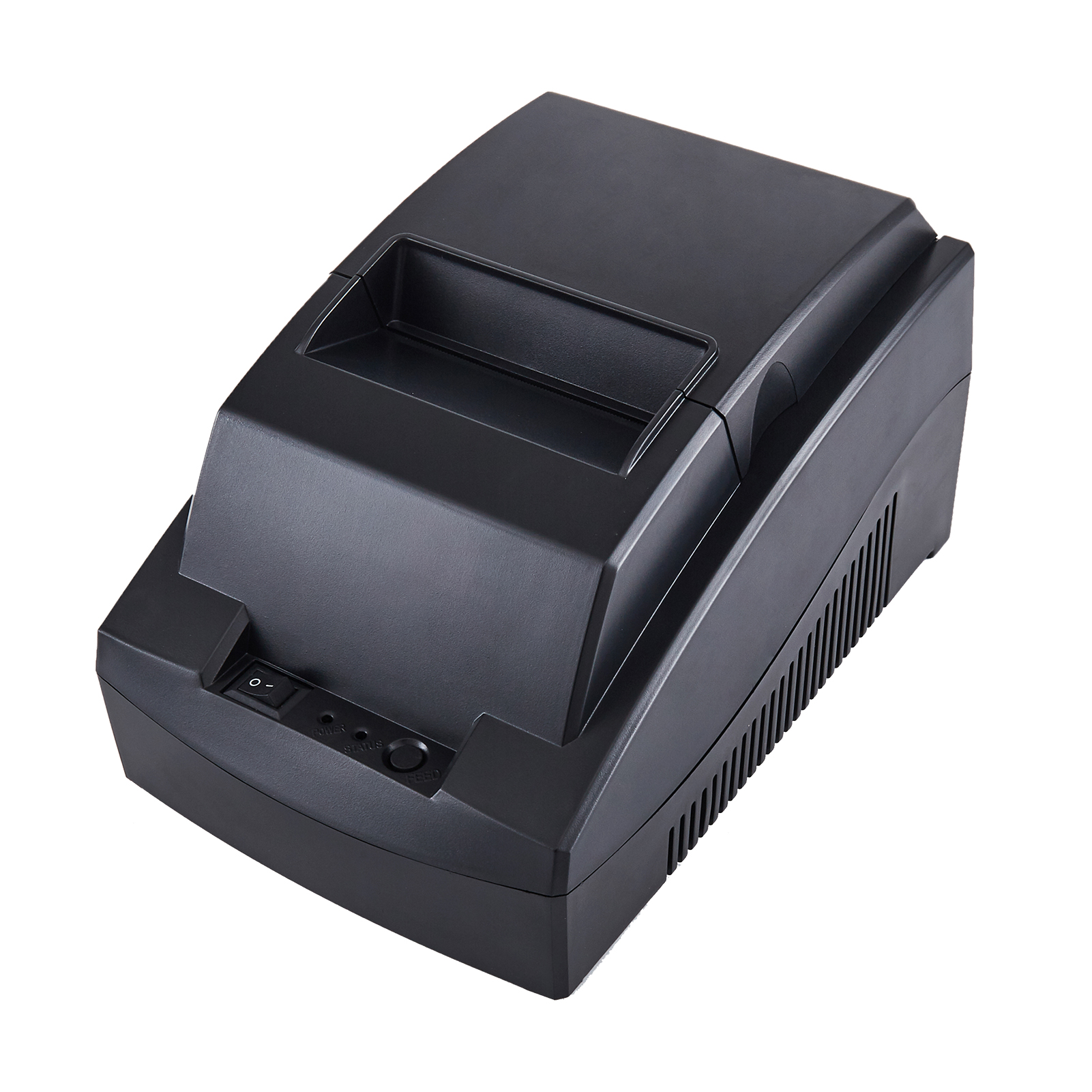
Cable management remains a hidden operational hazard. Standard printers use external power bricks. These bricks usually sit on the floor under the counter. Staff members accidentally kick them. They trip over the cables. The constant movement causes wire wear. It also leads to accidental unplugging mid-transaction. We eliminate this risk through superior design. We strongly recommend deploying a 58mm Thermal Receipt Printer with Built-In Adapter. It streamlines installation immediately. It secures power delivery within tight teller pods. You remove the external brick entirely. This protects the power source from accidental physical disruption.
You must carefully evaluate paper path architecture. We advise selecting front-exit designs. You should avoid top-exit models in banking environments. Top-exit units feature an opening pointing upward. This opening collects ambient dust over time. It also welcomes accidental liquid spills from teller beverages. Front-dispensing designs solve these issues. They protect internal mechanisms from falling debris. They significantly reduce paper jams in under-counter deployments. A front-exit path ensures the paper feeds smoothly toward the customer.
Cutter mechanisms define long-term hardware survival. You must differentiate between consumer-grade guillotine cutters and commercial rotary cutters. A guillotine cutter pushes a straight blade directly downward. It struggles during partial cuts. The blade frequently locks up. High-volume environments require robust rotary cutters. A rotary cutter uses an angled slicing motion. It cuts through thick thermal paper effortlessly. It prevents blade locking. It handles continuous print cycles without jamming.
Resolution selection impacts printhead lifespan. Many buyers assume higher resolution is universally better. This is a common mistake. We recognize 203 DPI as the true industry sweet spot. A 203 DPI printhead renders crisp text perfectly. Higher DPI generates excess heat on the printhead. This heat accelerates component degradation. It does not add necessary value to basic financial text. You gain longevity by sticking to standard resolutions.
Financial institutions must look beyond initial hardware procurement. A poorly constructed printer drains extensive operational resources. You might acquire a cheap unit easily. However, if it requires IT intervention twice a year, it wastes valuable staff time. A premium module prevents these persistent interruptions. You should evaluate the complete lifecycle of the device. Quality engineering keeps branch operations running smoothly. It reduces the burden on your technical support teams.
Consumable economics also favor the narrower format. 58mm paper rolls inherently reduce physical paper consumption. You use less material for each transaction. When you scale this across hundreds of bank branches, the efficiency gains multiply. Narrower rolls mean less bulk storage required in branch backrooms. It streamlines inventory management. It aligns perfectly with corporate sustainability goals.
Internal sensors prevent mid-transaction failures. A commercial printer must include robust optical sensors. "Black mark" sensors detect pre-printed forms accurately. "Paper near-end" sensors warn tellers before the roll depletes. You can replace the roll proactively. This prevents a receipt from stopping halfway through a withdrawal. You maintain a professional customer experience. You never force a customer to wait for a paper change.
You should establish a structured 5-year hardware lifecycle evaluation. Use this specific framework to model equipment longevity:
Deployment Metrics: Measure the average daily transaction volume per teller station.
Maintenance Intervals: Schedule regular printhead cleaning cycles to prevent residue buildup.
Mechanical Lifespan: Ensure the rotary cutter guarantees at least 1.5 million clean cuts.
Printhead Endurance: Verify the printhead can output at least 100 kilometers of continuous paper.
Support Overhead: Track the number of IT tickets generated by paper jams or cable faults.
Hardware installed in financial environments must adhere to strict electrical safety standards. You cannot embed uncertified equipment into ATMs or secure teller counters. Built-in adapters and mainboards must meet rigorous international codes. They usually must pass IEC 62368-1 certification. This is a hazard-based safety engineering standard. It ensures the equipment handles power fluctuations safely. It prevents electrical fires in enclosed kiosks. Compliance here is absolutely non-negotiable.
Occupational health remains a major Environmental, Social, and Governance (ESG) priority. We see a mandatory industry shift toward BPA-free thermal paper. Bisphenol A is a chemical coating used in older thermal paper. It poses potential health risks. Tellers handle hundreds of receipts every single shift. They absorb these chemicals through their skin. Your printer must provide high-contrast prints on BPA-free media. It must perform perfectly without requiring chemically aggressive paper coatings. You protect your employees by adopting healthier consumables.
Audit trails present a unique technical challenge. Thermal printing relies on heat. The print naturally fades over extended periods. Banking regulations often require seven-year document retention. A faded receipt cannot pass a compliance audit. We solve this through a modern mixed-architecture approach. The compact printer handles the immediate customer handoff. It provides a quick, physical record. Meanwhile, the backend system securely logs a digital twin. This digital record satisfies long-term regulatory retention rules. You get speed at the counter and compliance in the database.
Integration with legacy systems dictates deployment success. You must assess the ease of software deployment before purchasing hardware. The chosen printer must offer robust software development kits (SDKs). It needs stable driver support for older banking operating systems. Many branches still run custom Linux builds or older Windows versions. The hardware must bridge these legacy systems alongside modern, cloud-based teller interfaces. Driver conflicts cause immediate branch-wide outages. You need versatile compatibility.
You must choose between modular and embedded rollouts carefully. Standalone desktop models work best for physical tellers. They allow quick access for paper loading. ATMs and self-service kiosks require modular designs. These units feature slide-out mechanical rails. Modular designs allow for tool-less hardware swapping. A technician can slide a broken unit out instantly. They bypass the need to reboot the core kiosk operating system. This modularity reduces ATM downtime from hours to minutes.
Procurement teams should adopt strict shortlisting logic. Always request physical testing units before a fleet-wide rollout. You cannot judge enterprise hardware strictly from a specification sheet. Your pilot program should test specific operational stress points. Evaluate the continuous print-and-cut cycles under heavy load. Verify the ease of drop-in paper loading by non-technical staff. Test the driver stability during simulated network fluctuations.
Shortlisting Category | Pilot Test Criteria | Success Benchmark |
|---|---|---|
Mechanical Stress | Run 500 consecutive cut cycles. | Zero jams. Clean paper edges. |
Usability | Have a new teller load paper. | Takes under 10 seconds. No training needed. |
Power Stability | Simulate cable tugging. | Built-in adapter holds secure. Power stays on. |
Software Resilience | Disconnect and reconnect USB. | Driver recovers automatically without OS reboot. |
In financial services, a receipt printer operates as a critical transaction finalizer. It is never an afterthought. The 58mm format perfectly bridges the gap between severe spatial limitations and high-reliability demands. It fits neatly into modern teller pods. It provides necessary transaction details without wasting paper on retail-style graphics. You protect operations by choosing smart designs. Front-exit paths prevent jams. Built-in adapters eliminate hazardous external power bricks.
Operational leaders should take immediate action to optimize their hardware fleet. First, audit your current hardware failure logs to identify bottleneck locations. Second, map out your physical counter space to confirm spatial constraints. Finally, request enterprise-grade evaluation units. Ensure your shortlisted units feature built-in adapters and front-exit architecture. These specific features will dramatically improve your branch efficiency and teller satisfaction.
A: No. It utilizes direct thermal technology, relying entirely on heat-sensitive paper. This eliminates ink procurement and reduces internal mechanical complexity.
A: A 58mm thermal receipt printer with built-in adapter eliminates external power bricks. This saves critical under-counter space, prevents staff from accidentally kicking or unplugging the power source, and simplifies cable routing through secure teller glass.
A: Standard thermal paper lasts 1-3 years, but specialized archival thermal paper paired with proper storage (away from heat and UV light) can last 10-30 years. Banks typically pair physical customer receipts with secure digital logs for long-term compliance.
A: Yes. A standard 203 DPI 58mm printer is fully capable of rendering crisp QR codes for digital banking app downloads or branch appointment scheduling, though complex graphical logos should be kept minimal to maximize print speed.


